Intermittent fasting – the good, the bad and the hungry
by Ellen Hart, LiveLighter Campaign Senior Coordinator
- May 1, 2022
- Leave a comment
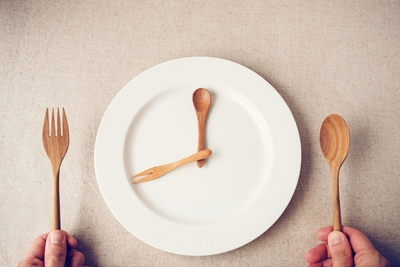
It’s 10.30AM and I am hungry. Very hungry. Some may even say hangry (sorry team). I am this hungry because I’ve just started intermittent fasting (or IF for short). As someone who loves food and plans her snacks religiously, the prospect of fasting is pretty daunting. Recently I had to fast several times (including a full 24 hours) due to some medical testing. I’d heard a lot about fasting in the news and wanted to experiment with following this approach. Here’s what I learned and how I went.
What is intermittent fasting?
Intermittent fasting involves following a schedule where at different times you eat normally, go without food, or go with very little food. There are several different ways that this can be done. You may have heard a few different names before, such as the 5 and 2 (where you eat normally on 5 days, and very little on 2 days) or 16/8 (where you only eat during an 8 hour window each day). While fad diets focus on a narrow range of foods and are unsustainable in the long term, IF is more of a lifestyle change that doesn’t require cutting out particular foods or constant restriction.
Following an IF regime though is not a licence to eat as many chips, chocolate and pastries during the eating window as you can. Instead the focus should be on getting a balanced diet that emphasises vegetables, fruit, wholegrains, dairy and protein foods. Although people may find that they consume less energy (kilojoules) while doing IF, there is no focus on reducing overall kilojoule intake.
How do you do it?
There are a number of ways to approach IF and none has been found to be superior to the other in terms of health benefits.
Time-restricted eating
The simplest approach to IF is to fast for a set period of time each day, from 12 to 20 hours per day. This means an eating window of between 4 and 12 hours each day! As an example, a 12-hour fasting period could be achieved by not eating between 7PM and 7AM. The length of time and hours during which you eat can be adjusted according to your needs. A 12/12 approach (i.e. a 12-hour eating window) may be best for people who haven’t tried IF before, or for those who struggle to go for long periods without food. I’ve been trialling the 16/8 approach (i.e. an 8-hour eating window) and have found it surprisingly palatable (excuse the pun).
Intermittent fasting (5:2 diet)
This involves eating normally for five days of the week and then eating only 2000-2,500kJ (500-600 calories) for the other two days of the week. There are no restrictions on what can be eaten but as mentioned above, a nutritious diet is still recommended.
What are the benefits?
While fasting diets have received plenty of positive buzz over the past 7 years, we all know that the most popular diets are not always the ones backed up by science.
Fortunately, in the case of IF, a number of studies have been conducted and have found that this diet is generally safe for healthy adults and can lead to benefits like:
- Weight loss
- Reductions in glucose and insulin levels
- Improvements in blood lipids (like LDL and HDL)
- Lowered blood pressure
It’s likely that any weight loss is due to a reduction in overall energy intake. This means that if weight loss is your goal, it’s important to emphasise healthy foods in sensible portions during the eating window. Interestingly, research has found that IF is as good as continuous energy restriction for weight loss (i.e. what we would normally think of as a "diet"). However some people may find IF easier to follow as you only have to control how much you eat some of the time.
My interest in IF was sparked by claims relating to gut health. Although there’s not a lot of scientific research to back it up I had seen reports that IF may improve gastro-intestinal symptoms like bloating. As I have experienced gut health issues over the past year I was keen to see if following the IF diet could help improve my symptoms.
Did I (and the rest of the LiveLighter team) survive the trial?
Fast (ha) forward two months and although I have not seen many physical changes, the diet has helped me think more about how and when I eat. I have noticed some minor improvements to my gut symptoms (but nothing particularly significant) and no differences in my weight.
After some trial and error I found that eating my evening meal earlier (finishing by 8pm at the latest) and then having a late breakfast at around 10 or 11 was easier than having a late dinner and not eating again until noon or 1pm. Additionally, I found that having an earlier dinner meant I didn’t go to bed with a full tummy which helped me sleep better, win-win! Between work, going to the gym and walking the dog it wasn’t always possible to eat early though and I didn’t stress or adjust the fasting period for the next day if I ate a bit later in the evening.
Something I found difficult was increased hunger in the afternoon even when I had eaten (a late) breakfast and lunch. This meant it was harder to not reach for chocolate to get through the 3pm slump! Making sure I had healthy snacks available was vital.
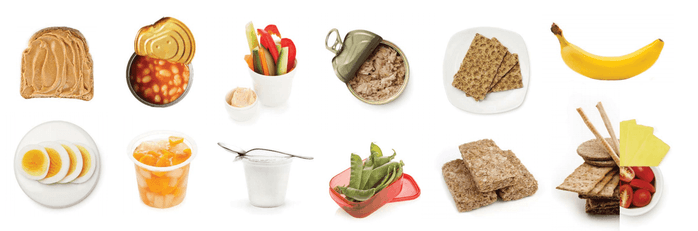
Healthy snacks to get me through the mid-afternoon slump!
Take home points
Overall I found intermittent fasting easier than I had expected and I plan to continue it for the foreseeable future, although probably in a more relaxed version where I actively fast for only a couple of days each week. This way of eating may be worth trialling to see if it works for you, however, it is not suitable for everyone, particularly those who have a disordered relationship with food or who have experienced this in the past. If weight loss is one of your goals then IF may be a sustainable and effective approach for some. Ultimately, the best diet for you is one that includes all the food groups and that you are able to follow in the long term.